Used Track Motorcycle: Danger or Good Deal?
"This motorcycle has never seen the track." That's the most common phrase heard on LeBonCoin when buying a used sportbike. But how do you verify it? And above all: is a motorcycle that's been on the track necessarily a bad purchase?
Spoiler: not at all. A well-maintained track motorcycle is often in better mechanical condition than a road motorcycle mistreated by potholes and traffic lights. You just need to know how to recognize it and check the right points.
The 10 Signs That Betray a Track Motorcycle
1. Tire Wear on the Edges
This is THE most obvious sign. A road motorcycle has tires worn in the center (straight line). A track motorcycle has tires worn on the edges, sometimes down to the lateral wear indicators while the center is still in good condition. "Marble" or "tears" on the sidewalls (sport or slick tires) confirm intensive track use.
2. Scratched or Worn Fairing Sliders
Sliders (protection mushrooms) mounted on the frame or swingarm are a strong indication of track use. If they are scratched or flattened, the motorcycle has slid on the ground — which is not uncommon and often without consequence on the mechanics.
3. Tape Residue
Residue of gaffer tape on the headlights, turn signals, instrument panel, or mirrors. These elements are systematically taped up on the track. Sticky residue or peeling marks are almost formal proof.
4. Rearsets
Footpegs repositioned higher and further back than the original = typical track modification. This allows for more ground clearance in corners. On a motorcycle that has "never seen the track," there is no reason to install this.
5. Engine Case Protectors
Aluminum or plastic protectors bolted onto the engine cases (alternator, clutch). Their only purpose: to protect the engine in the event of a slide. If it's mounted = the motorcycle has been on the track.
6. Folding Levers
Folding brake and clutch levers (that fold instead of breaking). Mounted almost exclusively by track riders to avoid losing a lever in the event of a fall. On a road motorcycle, the original levers are kept.
7. Safety Wire
Safety wire passed through the oil, coolant, or brake caliper bolts. This is mandatory on many circuits. If you see safety wire or its traces (holes in the caps), it's 100% track.
8. The Fairing
Two revealing scenarios:
- Track fairing (without lights, often in fiberglass or plain plastic) = assumed track motorcycle.
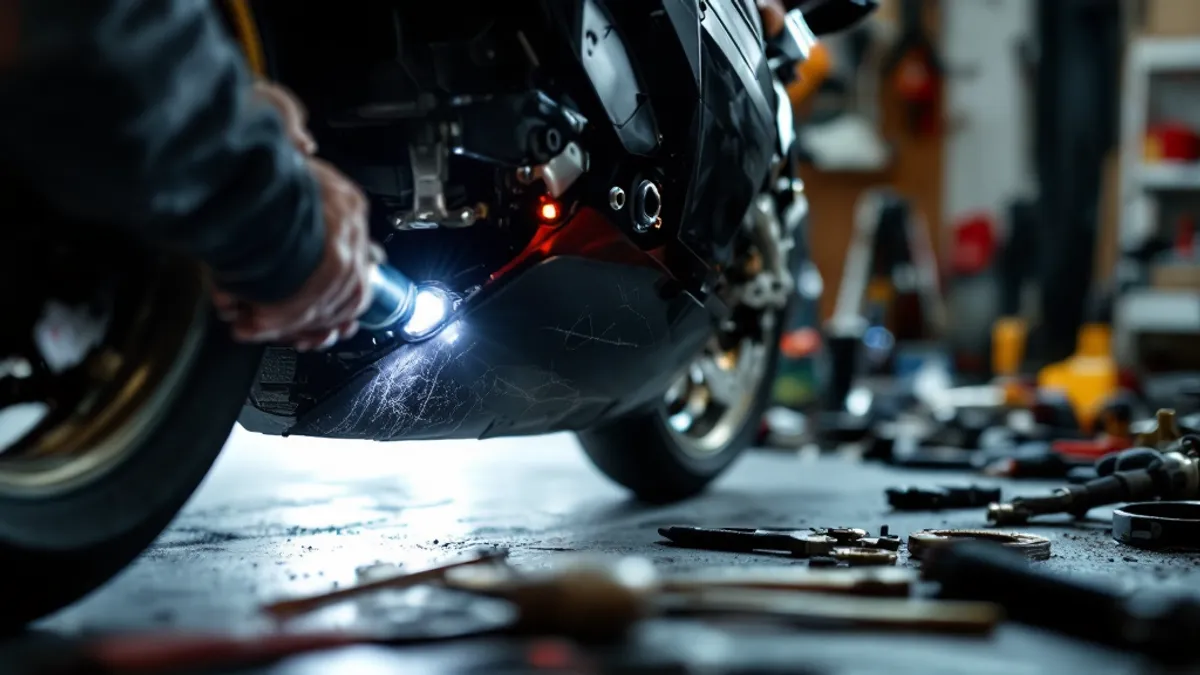
- Original fairing with micro-scratches or partially repainted = the motorcycle has probably fallen and then been cosmetically repaired.
9. The Odometer
Few kilometers on the odometer but a mechanical condition that suggests intensive use (worn pads, loose chain, tired tires). On the track, you ride 100-200 km per day but at an intensity level 5x higher than on the road.
10. Specific Modifications
- Additional oil cooler
- Racing brake fluid reservoir (larger)
- Sport exhaust system (not road legal)
- Racing fuel cap (quick release)
- Absence of side stand (removed to save weight and ground clearance)
Is it Serious if a Motorcycle Has Been on the Track?
Not necessarily. And it's often a good sign. Here's why:
The Advantages of a Used Track Motorcycle
- More rigorous maintenance: a track rider changes the oil, pads, and tires much more often than an average road user. The mechanics are often better maintained.
- No urban traffic: no stop-and-go, no speed bumps, no repeated cold starts. The clutch, gearbox, and engine have had a less stressful life in some aspects.
- Passionate owner: someone who invests in track riding generally takes care of their machine.
Points to Watch Out For
- Did the motorcycle fall? Ask directly. An honest rider will tell you how many crashes the motorcycle has had. A low slide (the majority of falls) damages the fairing but rarely the mechanics. A highside (violent wheelie) is more problematic: check the frame, fork, swingarm.
- High revs permanently: on the track, the engine runs high for long periods. Engine wear is real, especially on 600/1000cc pushed to the limit. Check the compression, listen to the engine when cold (timing chain noises, clatter).
- Tired suspension: the suspensions work much harder on the track. Check that there is no fork oil leak and that the rear shock is not soft.
Purchase Checklist: Used Sport Motorcycle
- Ask for the history: number of track days, possible crashes, modifications. A seller who admits to track use is more reliable than one who hides it.
- Inspect the frame: traces of impact, chipped paint at the anchor points, straight steering head (turn the handlebars from stop to stop).
- Check the brakes: disc thickness (measure with calipers vs. minimum dimension indicated), condition of the pads, lever behavior.
- Listen to the engine: cold start, warm-up, stable idle speed, no knocking or whistling.
- Test the fork: pump the fork several times. No oil leaks, smooth return, no "play" in the tubes.
- Look at the chain: regular wear, no stiff links, correct tension.
- Negotiate accordingly: a track motorcycle that is admitted to should be negotiated 10-20% below an equivalent motorcycle that has "never seen the track." This is normal and expected.
Frequently Asked Questions
Does a Track Motorcycle Lose Value?
Yes, approximately 10-20% depreciation compared to an equivalent road motorcycle. This is paradoxically an advantage for the buyer: you often get a mechanically better maintained motorcycle for less.
How to Tell if the Frame is Bent After a Fall?
Turn the handlebars from stop to stop: it should turn freely and symmetrically. When riding, the motorcycle should go straight when you release the handlebars (hands resting, not gripping). If it pulls to one side, the frame or fork is probably bent.
Should You Avoid a Motorcycle That Has Been on the Track?
No. A well-maintained track motorcycle, with a transparent history and no serious crashes, is often a better purchase than a road motorcycle with an unknown past. The important thing is the honesty of the seller and the quality of the maintenance.